






Suzy Says!
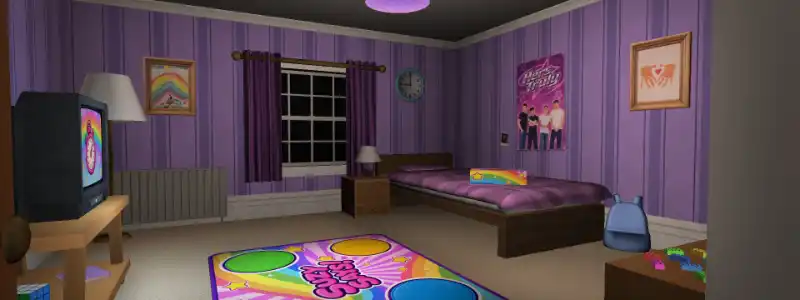
In Suzy Says! you start standing on a four-color floor mat in front of an old CRT television, home alone, with a children's DVD your uncle left behind already spinning in the player. That detail matters more than it looks. The smiling host on the screen, Suzy, is about to give you a long list of orders, and the whole run depends on one tiny habit: you only move when her sentence begins with her own name. Miss that, obey a line she slipped past you without it, and the cheerful show starts to bite back.
What Suzy Says! Asks of You
At its core, this is Simon Says turned into first-person horror. The DVD is styled like an interactive kids' program from the mid-2000s, with a bright menu, a jingle-heavy intro and a host who talks straight to the viewer. Suzy calls out colors, objects and actions, and you carry them out with your own body: jumping on pads, crouching, turning your head, walking to a room and touching something. A full story run takes roughly 17 to 20 minutes, which is short, but every one of those minutes is built around listening.
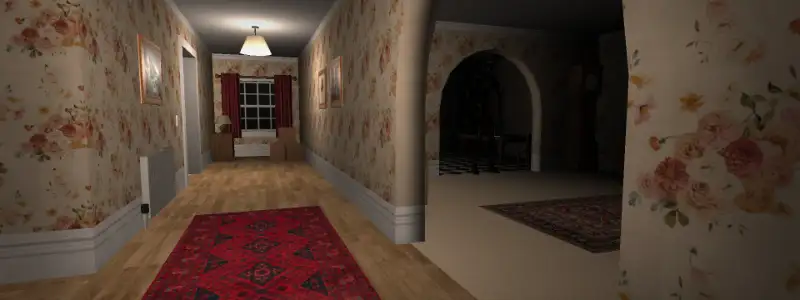
The setting never leaves one suburban house. The living room holds the television, the mat, the couch, the radio and a sunflower painting. A hallway with floral wallpaper leads to the kitchen with its fridge drawing, the bathroom with a rubber duck, the bedroom and the front door.
That small map is deliberate. Early on, the house feels like a safe stage set around the show, and you only leave the mat because Suzy tells you to. By the time the special friend shows up at the windows, you already know every corner, and that familiarity is exactly what makes the later chapters so uncomfortable. Players who love tight, single-location horror tend to click with it right away, because nothing is wasted and every room gets used twice.
Story-first players get a complete arc with a beginning, a twist and three different finales, while score chasers have a separate mode waiting once the plot is done. Suzy Says! is also a rare horror pick that works well for viewers who dislike long campaigns, because a whole evening covers the story, both extra routes and a few attempts at a high score.
Want the whole route in order before you start? The chapter-by-chapter walkthrough lays out every command from the first mat jump to the final scene, so you can check a step without spoiling the rest.
| Style of horror | First-person mascot horror with psychological pressure |
|---|---|
| Where it runs | Windows download; no phone, console or browser build |
| What you actually do | Obey commands that start with "Suzy says" and ignore every other line |
| Faces and objects to know | Suzy, the special friend, Mom, the DVD, the four candles, the radio |
| Where it happens | One family house: living room, kitchen, bathroom, bedroom, hallway |
| Ways to play | Story Mode, plus Endless Mode in the Full version; three endings |
The Prefix Rule and Suzy's Traps
Everything comes back to the prefix. A command only counts when it starts with Suzy's name. The opening minutes drill this into you with a calm color routine, and then she starts dropping her name on purpose to see whether you are actually listening or just reacting to the last word you heard.
"Suzy says, jump on red."
"Jump on green."
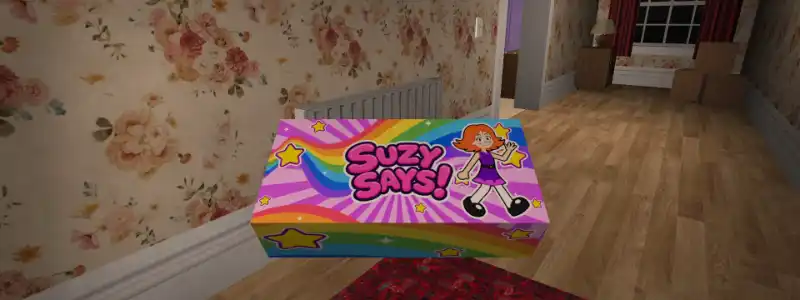
The first line is a real order. The second is bait, and the correct response is to stand perfectly still. The community calls these bare lines "no-prefix traps", and almost every early mistake in public playthroughs comes from one. Suzy even points it out when you fall for it, reminding you she never said her name, which is a small but memorable sting the first time it happens.
The rule never changes, but the pressure around it does. Early on, commands arrive one at a time with pauses between them. Once you leave the mat, they mix colors, look commands and trips through the house, and the gap between lines shrinks. By the time the visitor arrives, the camera is being pulled toward the window and the floor while new instructions keep coming, so reading the subtitle fully before you move is the single most valuable habit you can build.
Experienced players treat stillness as the default answer. Doing nothing after a real command costs you little in the opening chapters, while obeying a fake one triggers a scare and, later, much worse. Speedrunners take the opposite gamble and react fast, but even they learn to wait for the full sentence on the lines that decide the ending.
Mistakes Almost Every New Player Makes
The first classic error is reacting to the color instead of the sentence. Your eyes catch "red", your fingers press Space, and only afterwards does your brain register that the prefix was missing. The second is moving the mouse while Suzy is still talking: a casual glance at the window can be read as obeying a look command you were supposed to ignore. The third is heading back to the mat on your own after a touch command, which wastes the moment when the next line arrives.
None of these are about skill. Suzy Says! punishes impatience far more than slow reflexes, and slowing down by half a second fixes most of them.
Turn subtitles on. They show the full line at once, so you can check for the prefix with your eyes instead of trusting your ears during the loudest moments.
Controls on the Mat and Around the House
The input set is tiny, and that is part of the charm. There are no menus to manage, no inventory screens and no weapons. Your body on the mat is the controller, and every key maps to something Suzy can ask for.
- W A S D: walk around the mat, through the hallway and into every room.
- Spacebar: jump onto a colored pad, the bed or the couch when told to.
- C: crouch down on command.
- Mouse movement: look at Suzy on the TV, at the floor, the ceiling, the window or behind you.
The mat itself has four pads: red, green, blue and yellow. Learn where each sits during the tutorial, because later rounds chain colors quickly and you will not have time to glance down. Standing in the middle between jumps keeps every pad one short hop away, which is the simplest positioning trick in the whole run.
Look commands are easy to underrate. Turning to the ceiling or behind you follows exactly the same prefix rule as a jump, and an idle flick of the mouse at the wrong moment can count as obeying a bare line. Keep the view resting on the television between orders, since that is where the next instruction starts anyway. The full list of keys and every command they answer is collected on the command list page.
The layout of the mat never changes between runs, so muscle memory carries over. Many players report that by their second playthrough of Suzy Says! they hit every color without looking, which leaves their attention open for the one thing that matters: the first words of each line.
A smaller detail that only shows up in play: precise positioning matters for touch commands. Walking right up to the sunflower painting or the fridge before interacting makes the action register cleanly, while stopping a step short is one of the reasons players feel "robbed" by the game.
From the Color Mat to the Candle Hunt
The story unfolds in clear stages, and each one stretches the same rule a little further. Knowing the order will not make it painless, but it does help you recognize when the stakes are about to rise.
- The mat tutorial. Color jumps on red, green, blue and yellow, with no tricks yet.
- Prefix traps. Suzy starts dropping her name and asks you to look at her.
- Leaving the mat. Touch the sunflower painting, come back, then find the rubber duck in the bathroom.
- Strange events. Crouch, look at the floor and the window, then touch the drawing on the fridge.
- The visitor. Suzy announces a special friend, tells you to look behind you and to close the front door.
- The call. Mom phones home, and Suzy cuts the line.
- Hide and seek. The creature searches the house while you stay out of sight.
- The candle hunt. Jumps on the bed and couch, then four candles brought to the mat.
- The symbols. One last look, and the show ends.
The fridge drawing is the turning point, and it is a moment almost everyone remembers from Suzy Says!. It shows the player and Mom, plus a dark silhouette that was not part of the picture before. From there the tone shifts fast: the windows stop being scenery, the front door becomes the focus of the scene and the house that felt like a playground starts to feel like a trap.
The hide sequence is where most first runs end badly. Once the creature starts walking the halls, stay away from open doorways and keep solid walls between you and its route. A few players report that everything outside the TV room went pitch black during this part; restarting the run cleared it for them, and the troubleshooting guide keeps track of that and the other known issues.
Advanced players use the touch commands as scouting trips. Every walk to the sunflower painting, the rubber duck or the fridge is a bonus chance to learn sight lines, doorways and corners before the creature ever arrives. When the hide order finally comes, they already have a spot picked out, usually a room with a wall between them and the hallway rather than a dead-end corner.
The candle hunt is calmer but easy to fumble. Carry each candle straight back and check that it actually landed on the mat before going for the next. One player reported a fourth candle that refused to sit in place, and another noticed that dying in this section reset the living-room clock and the board game, a neat hint that you have been sent back to the start of the chapter.
Story Mode, Endless Mode and the Full Version
Story Mode is the main experience and the one everybody plays first. It follows Suzy's show from the first jump to the final scene, runs about 17 to 20 minutes and contains two of the three endings. The goal is simple to state: survive the visitor and the hide sequence, finish the candle ritual and see what Suzy has planned. Mistakes in the early chapters cost you a scare, while mistakes at the front door or during the hide end the run outright.
Endless Mode in Suzy Says! strips the story away and keeps only the commands. Suzy keeps calling out orders without chapters, cutscenes or a finale, and every missed or wrong move adds an X mark to the screen. It is a pure score chase, which suits players who enjoy beating their own records more than following a plot. One player reported a score of 802, a decent benchmark for a long run.
The Full version is what unlocks Endless Mode and the Secret Ending. The standard download covers Story Mode with the Bad and True endings, and the Full version starts at $1.50. If you already know you want every ending, grab the Full download from the start so the second playthrough is ready when you finish the first; the download guide compares the two files side by side.
A practical order works best for most people. Play Story Mode first without guides, then read up on the routes and replay for the missing endings, and only then move to Endless Mode, when the colors are fully drilled into your hands. Jumping straight into Endless Mode on day one tends to be frustrating, because the prefix traps come faster there than anywhere in the story.
Endless Mode is also the best training ground for the story. A few short score runs sharpen your reaction to bare lines so much that the visitor scene and the candle hunt feel noticeably calmer on the next replay, and the X marks give honest feedback on exactly how often you still jump too early.
The difference between the modes is mostly about attention span. Story Mode gives you room to breathe between chapters and rewards learning the house, while Endless Mode is all reaction and discipline on the mat, with nothing to look at except Suzy and the next line.
Bad, True and Secret: The Three Endings
Three endings are known, and they line up neatly with the theme of obedience. Two come from the regular story and one needs a second run in the Full version. Videos label them differently, calling the main one True, Good or Normal, but they all describe the same scenes.
| Ending | How it triggers | What you see |
| Bad Ending | Open the front door for the special friend, or get spotted during the hide | The creature catches the player and the run ends |
| True Ending | Place four candles on the mat, then obey the final look at the symbols | Suzy puts the player to sleep and pulls them into the television |
| Secret Ending | Full version only: after the story, restart, eject the DVD and destroy it | Suzy loses her hold and the show stops for good |
The Bad Ending is usually the one players see first, and almost always by accident. Curiosity is the culprit: the knock is loud, the visitor is right outside and opening the door feels like progress. Getting caught during the hide is the other common route, especially for players who pick a hiding spot facing an open hallway.
The True Ending is the natural finale of a first run, and it lands hard precisely because you did everything right. The cheerful thank-you screen with your score comes straight after the player disappears into the screen, and that contrast is what people tend to talk about after their first finish.
The Secret Ending flips the message. After spending the whole story learning to listen to Suzy, the real escape is to stop playing her game and go after the disc itself. Community guides also tie the living-room radio into this route, so pausing near it during quiet moments is worth the few seconds. The full endings guide walks through every trigger in detail.
Suzy, the Special Friend and the Uncle's DVD
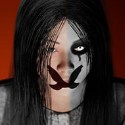
The cast of Suzy Says! is small, and most of it stays off screen. Suzy is the host, the voice and the threat all at once. She smiles from the CRT, gives every order, decides when you failed and, as the story goes on, takes control of the house itself: she ends Mom's phone call and invites her friend inside.
The special friend is the creature that first appears as a silhouette in the fridge drawing and at the windows, then arrives at the front door. It never gets a proper name, and that works in its favor. Mom is only a voice on the line and a figure in the drawing, while the uncle who left the DVD never appears at all. Lore fans enjoy picking at that gap, and the story explained page lays out what the game shows and what it leaves open.
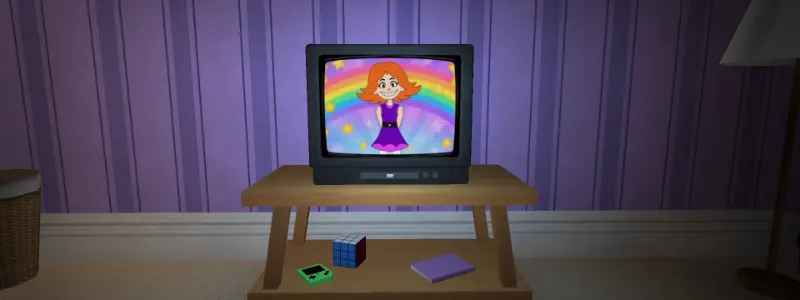
Why does the DVD format matter so much? Interactive kids' shows really did ask children to stand up, point and answer the screen, so Suzy's first requests feel familiar rather than suspicious. The disc is also a physical object you can hold and break, which is why the Secret Ending makes sense on a gut level. Fans of the Mr. Hopp's Playhouse series will recognize the same idea from that studio: a cute children's object turned into the villain, only here it is a DVD host instead of a plush rabbit. If you want each character broken down with their role in the plot, the character pages cover all of them.
Sound does a lot of the storytelling here. The jingle on the menu, the bright voice that never quite matches what it asks for and the silence that falls after the call is cut all mark the shift from kids' show to something else. Players who use headphones often mention the moment the cheerful music stops as the scariest part of the whole run, scarier than any jumpscare.
Players also argue about what the final symbols mean. Some compare them to the medallions from Mr. Hopp's Playhouse 3, while others read them as a ritual tied only to the disc. Nothing in the story confirms either view, which keeps the theory threads busy.
Where to Go After Suzy Says!
Once the credits roll, the natural question is what to play next. The catalog on this site is built around that question and split into five shelves, each matching one side of what makes Suzy's show work.
| Shelf | What connects it to Suzy | Good first pick |
| Mascot Horror | A friendly host or toy who turns out to be the danger | Amanda the Adventurer |
| Hide and Seek | Staying out of sight while something searches the house | Granny 3 |
| Anomaly Spotting | Rules, attention and noticing what does not belong | That's Not My Neighbor |
| Short Horror | A complete scare in one evening | Bloodmoney |
| Indie Horror | Small-team ideas built around one sharp mechanic | Zoochosis |
Amanda the Adventurer is the closest relative: another host on an old screen, another set of tapes, another series of questions that slowly stop sounding innocent. Fans of the front-door tension should try No, I'm Not a Human, where every knock forces a decision about who gets inside.
If the home-alone setup is what stuck with you, Fears to Fathom opens with a teenager left alone for the night and builds its dread from everyday details. Its Home Alone episode shares the same sense of a house that slowly stops feeling safe.
For mascots on a bigger scale, Poppy Playtime trades the living room for a toy factory, with Huggy Wuggy in the role of the smiling threat. The factory hides its story in tapes and posters, much like the details Suzy leaves around the house.
Rambley, the talking raccoon guide of Indigo Park, is another host you should not trust, this time on the screens of an abandoned theme park. He greets you as a guest, counts the days since the last visitor and walks you toward mascots that have not aged well, which will feel very familiar to anyone who survived Suzy Says!.
A longer list with short notes on each title lives on the games like Suzy Says page. Every game in the catalog has its own guide with the main threat, the setting and the goal explained, so you can pick by mood rather than by name.
Questions Players Ask Most
Why did Suzy punish me when I did what she said?
Most of the time the line had no prefix, so obeying it counted as a mistake. Check the subtitle: if it did not start with "Suzy says", standing still was the right move. A few players also report correct actions not registering, especially on the bed jump and the sunflower painting, so walk right up to the target before interacting.
How do you unlock the Secret Ending?
You need the Full version. Finish the story once, then start again and go after the DVD itself: eject it from the player under the television and destroy it. Listening to the living-room radio during quiet moments is part of the route according to community guides.
Is there a version for phones or the browser?
No. The only official release is a Windows download, and there is no phone app, console version or browser build. Pages offering an APK or an in-browser copy under this name are not official.
How long is one full run of the story?
A complete story run lands between about 17 and 20 minutes, depending on how fast you find the four candles. Chasing all three endings roughly doubles that, since the Secret Ending needs a second run.
Is it too scary for younger kids?
Probably, yes, at least under ten. Despite the bright kids'-show style, there are jumpscares, a creature that hunts you during the hide sequence and a dark final scene with the television. Teens who are fine with a short chase usually handle it well.
Suzy Says! packs a whole horror story into one rule, one house and about twenty minutes: learn the four pads of the mat, keep the front door shut when the special friend knocks, carry every candle home and decide, on your second run, whether the DVD deserves another play at all.